
Why Most Founders Fail at Content Marketing
And What the Smart Ones Do Differently

The Founder’s Blind Spot: Why Content Feels Like a Chore (But Should Be Your Superpower)
Founders are rarely short on ambition. They pitch vision to investors, rally teams, and move markets with confidence. They solve problems others don’t even see. But when it comes to content—arguably one of the most powerful tools for scaling trust—they hesitate.
Not because they don’t understand the value of content marketing, but because they’ve been sold the wrong version of it.
Some delegate it too early. Others dabble and lose steam. Many try to “show up online” without really knowing what they’re trying to say. And when the metrics underperform or the writing doesn’t sound like them, they assume content just “isn’t their thing.”
Here’s the truth: most founders aren’t failing at content because they’re bad communicators. They’re failing because they’ve never had to translate their own ideas into narrative.
They’ve never had to say the same thing ten different ways for ten different decision-makers. They’ve never had to lead with a message—not just a product.
That’s the real challenge. And it’s exactly where content becomes a strategic advantage—or a silent drag on growth.
This article is not a list of tips or trends. It’s a look into why brilliant, visionary founders so often underperform when it comes to content—and how to fix it with the right lens, support, and message clarity.
If you’re a founder, CEO, or business coach who wants content that builds momentum instead of draining energy, read on.
Section 1: Content Without Conviction — The CEO Who Has Nothing New to Say
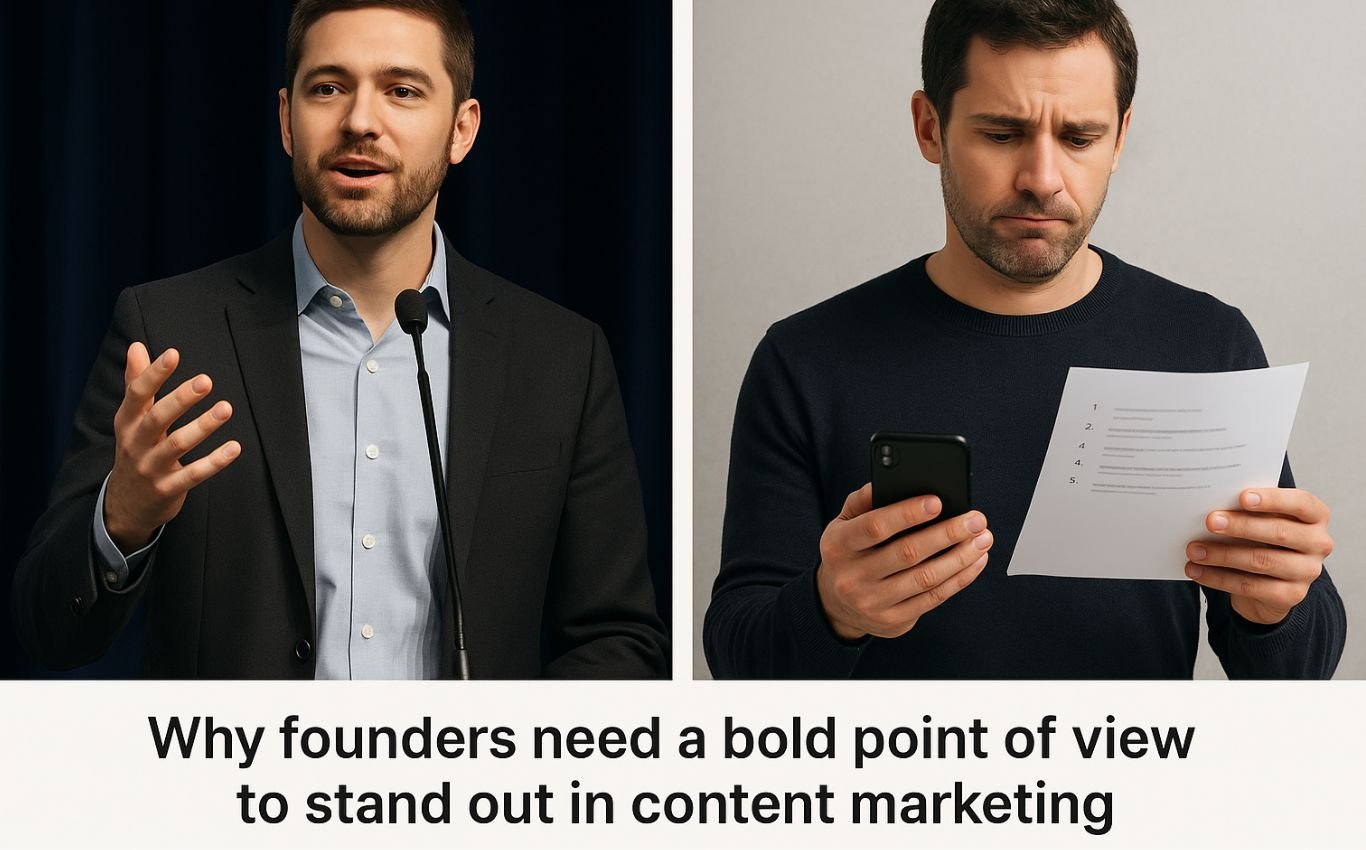
“Why founders need a bold point of view to stand out in content marketing”
“A confident founder shares a strong message, while another founder repeats generic tips — highlighting the difference between conviction and noise.”
Ask a founder what they want to be known for, and you’ll likely hear something vague. “Helping businesses grow,” “delivering exceptional service,” or “leading digital transformation.”
These aren’t messages. They’re descriptions. They don’t shape markets or start movements—they blend in with a hundred other brands saying the same thing.
It’s not because founders lack conviction. It’s because they haven’t been challenged to turn that conviction into a clear, memorable message. They default to industry jargon or safe language.
And in doing so, they rob their audience of the very insight that makes them valuable.
Founders often assume their product or track record should speak for itself. But in a world where attention is earned, not assumed, content becomes your amplifier.
And that amplifier is only as powerful as the clarity of your belief system.
The founders who consistently win at content aren’t necessarily the loudest. They’re the ones with a sharp edge to their thinking. They don’t just share what they do—they articulate what they stand against.
They say things like, “The agency model is broken—and here’s why.” Or, “If your product needs a 30-minute demo, it’s not differentiated.” Or, “In this economy, visibility is more powerful than efficiency.”
These are not just opinions. They’re positioning tools. And they work because they draw a line in the sand.
Conviction is magnetic. It repels the wrong audience and pulls the right people closer. But when content is watered down to be palatable to everyone, it lands with no one.
So why does this happen?
Often, it’s fear. Fear of being too niche. Fear of alienating peers. Fear of being wrong. Sometimes it’s perfectionism—a reluctance to publish anything that doesn’t feel “final.” More often, it’s a habit.
Founders are used to explaining things internally, to people who already trust them. But the external market requires a different type of clarity: one that challenges assumptions and cuts through noise.
If your content doesn’t say something distinct, it doesn’t matter how consistent or well-written it is—it won’t build momentum.
The first step is to stop trying to be liked by everyone. Instead, ask yourself: What’s the unpopular truth I’m willing to stand for? What belief, if said out loud and often enough, would make the right people remember me?
That’s where real content strategy begins—not with SEO keywords or social media formats—but with the courage to say something real.
Section 2: Delegation Without Direction — Why Writers Can’t Save a Vague Vision

One of the most common mistakes founders make with content is outsourcing it too early—long before their message is ready to scale. They hire a writer and hand over a vague brief, expecting them to “create thought leadership” or “build visibility.”
But thought leadership can’t be ghostwritten if the core thoughts are still unformed. Visibility doesn’t help if what you’re saying lacks clarity or edge.
What follows is predictable: the writing feels bland, off-brand, or surface-level. It’s grammatically correct, even polished—but it doesn’t feel like the founder.
It doesn’t sound like conviction. The content falls flat, not because the writer is bad, but because the direction was missing.
Writers are not mind-readers. They’re translators. And without a clear narrative, even the best ghostwriter will default to playing it safe—repurposing industry language, mimicking tone, filling space. What gets published might check the “we’re being consistent” box, but it rarely moves people.
This is not a failure of writing. It’s a failure of leadership messaging.
The reality is: message clarity is not something you can fully outsource. It has to be excavated. It’s a strategic exercise, not a copywriting task.
And unless the founder is involved in shaping it—through conversation, collaboration, and point-of-view extraction—the content will never reflect the depth of their thinking.
The solution is not to write it all yourself. It’s to partner with someone who understands the psychology of founders, the nuance of positioning, and the structure of narrative thinking.
A true strategic ghostwriter doesn’t just write. They ask sharp questions. They challenge your assumptions. They pick up on throwaway lines that reveal deeper beliefs.
They help you turn your internal clarity into external authority.
If your content team or ghostwriter isn’t pushing you to sharpen your message, they’re not helping you lead.
This is especially important for founders with complex offerings or disruptive ideas. The more nuanced your work, the harder it is to explain—and the more dangerous it is to hand that explanation off without proper framing.
In these cases, a traditional “content writer” is the wrong hire. You don’t need someone to fill your calendar. You need someone to help you build a worldview.
When content lacks a clear narrative, it becomes an expense. When it reflects a strong belief system, it becomes an asset.
So before you delegate your next article or campaign, ask yourself this:
If someone had to build a brand from my last five posts alone, would they understand what we stand for?
If the answer is no, the problem isn’t the writing. It’s the lack of a message worth repeating.
Section 3: Confusing Content with Communication — Building an Audience vs. Building Trust
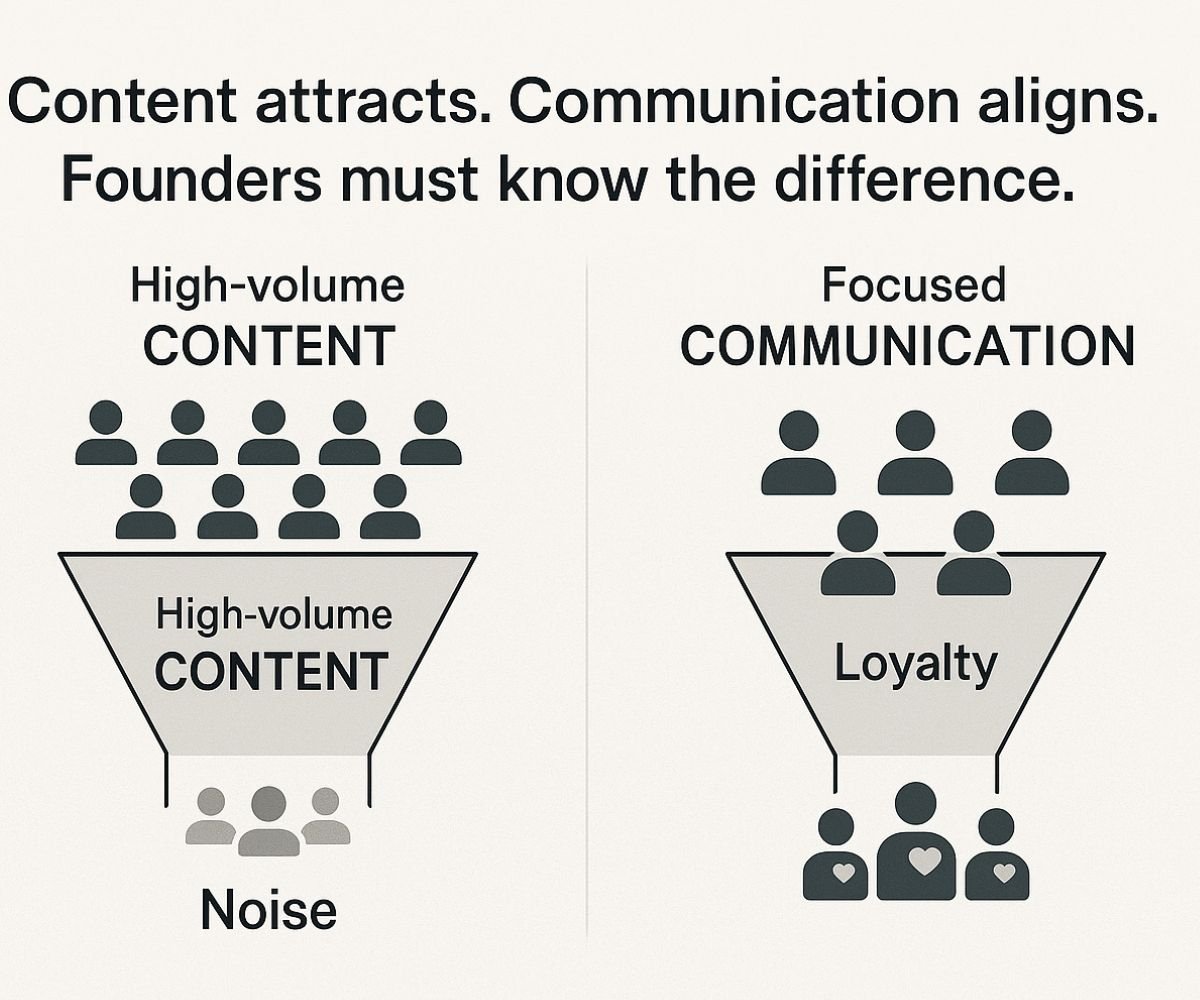
At some point, most founders realize they need to “create more content.” They hear it in investor meetings, from marketing agencies, even from peers who’ve built large followings.
And so they do what they’ve been told: they start writing blog posts, showing up on LinkedIn, maybe even launching a podcast.
On the surface, it looks like momentum. The publishing machine is running. The content calendar is full.
But underneath? Nothing’s moving. There’s no real engagement. No shift in brand perception. No clear message is being reinforced over time. The audience grows in numbers but not in depth. And the founder begins to wonder: Why isn’t this working?
It’s because they’ve confused content production with communication.
They’re saying a lot of things—but not saying anything that builds trust.
There’s a key distinction most founders miss: Content builds attention. Communication builds alignment. One can get you traffic.
The other earns you long-term belief, buy-in, and behavior change.
And the truth is, trust doesn’t come from volume. It comes from clarity, consistency, and courage.
It comes from a point of view that aligns with your ideal client’s unspoken problem—and articulates it better than they’ve ever heard before.
When content is treated like a checklist—“Post twice a week,” “Repurpose everything,” “Keep showing up”—it often becomes diluted.
The founder sounds interchangeable. Thought leadership gives way to thought mimicry. And that’s when content becomes a drain instead of a driver.
On the other hand, when content is treated like a relationship channel, everything shifts. You’re no longer writing to impress an algorithm. You’re speaking directly to the minds of the people you’re trying to serve, shape, and lead.
This is especially important for service-based founders and coaches whose value is rooted in trust, not transactions. If your business relies on people believing in your thinking, then content is not a nice-to-have.
It is the bridge to belief.
You don’t need more posts. You need more clarity.
Not just in what you do—but in how you see the world, and how your clients fit into that worldview.
The most effective content is not the most optimized—it’s the most aligned.
Aligned with your values. Aligned with your audience. Aligned with the future you’re building.
When your communication is clear, your content becomes effortless.
When it isn’t, no calendar will save you.
Section 4: Founder Psychology — Why Smart Leaders Self-Sabotage Their Message
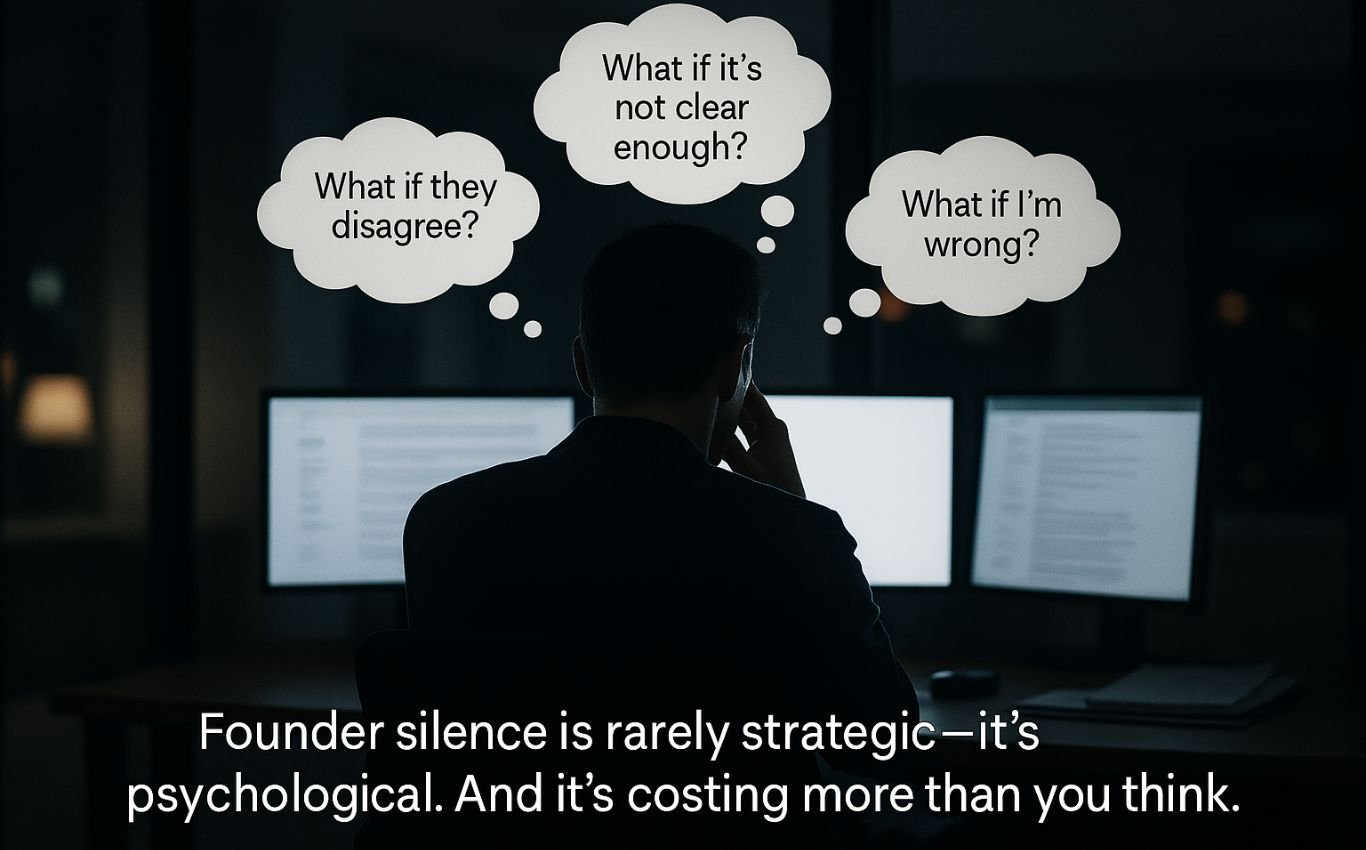
Some of the most intelligent, visionary founders are also the most silent online. They build great companies, hire exceptional teams, and make bold business moves behind closed doors.
But when it comes to showing up with clarity and conviction in public—through content, opinion, or thought leadership—they hesitate.
Not because they don’t have something to say. But because they’ve never been taught how to turn their thinking into a consistent message.
Or worse, because they’ve internalized the belief that it’s somehow not their job.
The truth is, founder silence isn’t a matter of laziness or lack of time. It’s usually rooted in psychology. In perfectionism.
In fear of saying the wrong thing. In the discomfort of being visible in an unpolished way.
This self-sabotage shows up in subtle forms.
It looks like obsessing over a single post for three days—and never publishing it.
It looks like saying, “I’ll write the article myself,” and then pushing it off for a quarter.
It looks like recording a video, then deleting it, because the lighting wasn’t quite right.
What’s really happening here isn’t a content problem. It’s a leadership moment.
Because content—especially founder-led content—is about identity. It’s about belief. And sharing beliefs requires vulnerability.
Many founders were taught to lead through performance. They perfected investor decks. Mastered sales calls. Presented “vision” in ways that feel polished and safe.
But content marketing—real content marketing—asks for something more honest: a repeatable story rooted in your values and worldview.
And that level of honesty can feel risky.
The risk of being misunderstood. The fear of being too early. The discomfort of not having the “perfect” articulation of your message yet.
So they stall. Or they default to delegating it all. Or they dilute the message to make it more “professional”—which usually means less human, less real, and ultimately, less memorable.
But the irony is: the more authentic the message, the more it resonates.
When a founder says something true, even if it’s raw or imperfect, people notice. When they express a belief that the market is already thinking but hasn’t heard out loud, it builds trust.
When they repeat it often enough, it becomes positioning.
The real skill isn’t just writing. It’s owning your voice.
And often, it takes an outside partner—someone who knows how to ask the right questions, spot the real story, and help shape the raw material into something magnetic—to make that happen.
If you find yourself rewriting the same paragraph over and over…
If you feel frustrated that your content “just doesn’t sound like you”…
If you keep delaying because it’s not quite right yet…
That’s not a quality issue. That’s a confidence issue.
And it’s fixable—not by pushing harder, but by clarifying your message, owning your position, and letting your voice evolve in public.
Because the truth is, the message will never feel perfect in draft one.
But until you hit publish, no one else can believe in it either.
Section 5: The Platform Trap — Why Founders Obsess Over Mediums, Not Messages
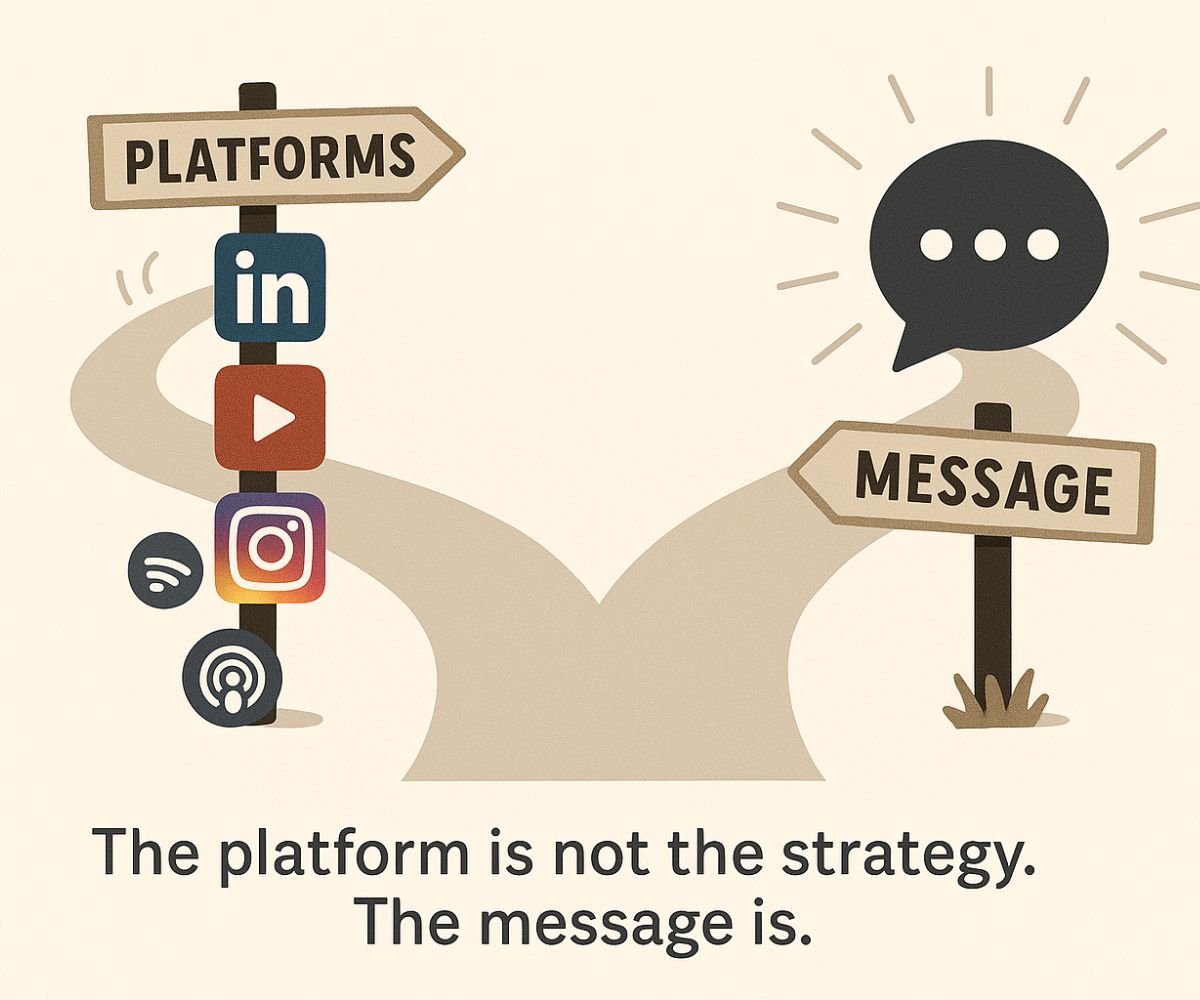
Ask a founder how they plan to grow their audience, and you’ll often hear answers like:
“We’re launching a podcast.”
“We’re testing YouTube Shorts.”
“I want to be more active on LinkedIn.”
These aren’t bad instincts. In fact, platforms matter. They determine discoverability, format, even tone. But they are not strategy. And treating them like strategy is one of the fastest ways to waste time and dilute your brand.
When founders obsess over where they should show up—without knowing what they want to say or why anyone should care—they end up scattered.
One week it’s newsletter consistency. The next, it’s a big video push. Then it’s back to zero because nothing “felt right.”
This platform-first mindset creates content that lacks continuity. It fragments your message across disconnected experiments. You end up with shallow brand recall and an audience that isn’t quite sure what you stand for—just that you’re showing up in a lot of places.
What’s missing isn’t volume. It’s coherence.
The founders who build lasting authority don’t jump from platform to platform hoping for traction. They anchor themselves in a clear message—a worldview, a strong opinion, a market stance—and then express that message across whichever medium fits best.
They know that great content doesn’t start with the question: “Where should I post this?”
It starts with: “What is the core truth I want to repeat until it sticks?”
When that core truth is solid, the platform becomes a distribution choice, not a distraction.
You can write an article, record a podcast, or host a fireside chat—and each of those outputs will reinforce the same belief. That’s how content becomes compound.
That’s how audiences remember. That’s how founders scale their message without splintering their focus.
This is especially relevant for founders with limited time. Because the more platforms you chase, the more diluted your presence becomes—unless every touchpoint reinforces a single, resonant idea.
So if you’re asking whether you should be on LinkedIn or YouTube or Threads or Medium—pause.
The better question is: Do I have a message that’s strong enough to echo across all of them?
Because the best content doesn’t come from being everywhere.
It comes from being unforgettable somewhere first.
Section 6: Trend-Chasing vs. Thought Leadership — Why Originality Compounds and Hype Fades
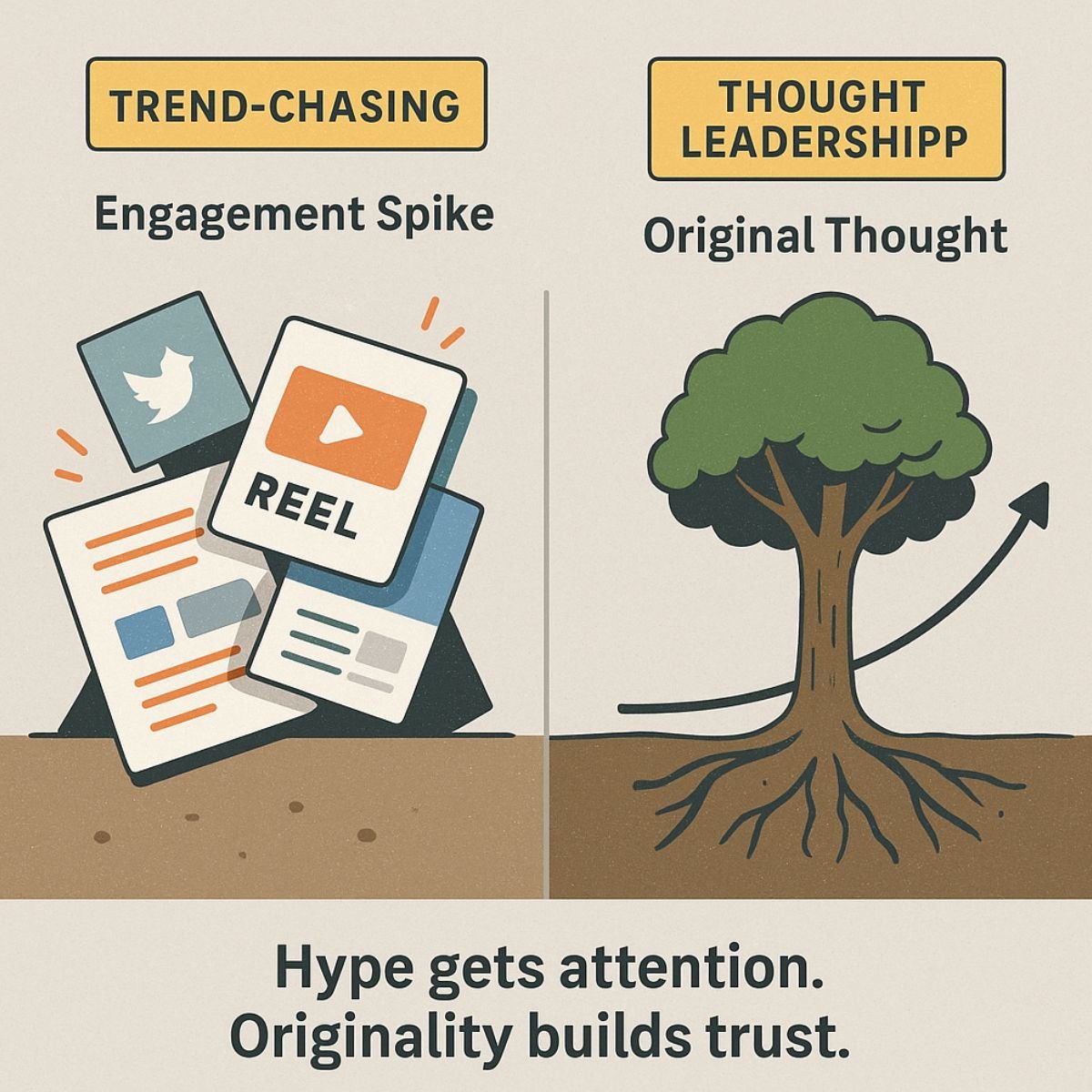
There’s a quiet pressure in the content world that few founders talk about openly. It’s the pressure to follow what’s working for everyone else. To mimic the latest growth hack, replicate a viral post format, or weigh in on whatever topic is currently dominating feeds.
It starts innocently. You see a competitor posting AI memes that get traction. A peer launches a content series that gains attention. Someone on LinkedIn shares a hook formula that “guarantees engagement.”
Suddenly, your strategy starts to shift—not because your message evolved, but because you didn’t want to fall behind.
This is how thought leadership gets replaced by content theatre.
Trend-chasing creates the illusion of relevance. It keeps your feed active and your calendar full. But underneath, it drains your clarity.
Because when your content is dictated by what’s popular, it rarely reflects what’s original. And when you lose originality, you lose authority.
Founders often fall into this trap because they mistake attention for trust. They assume that if something gets engagement, it’s effective. But short-term reactions are not the same as long-term resonance.
And audiences are smarter than we give them credit for. They can tell the difference between something crafted for likes—and something anchored in real conviction.
The most respected thought leaders don’t aim to be trendy. They aim to be timeless.
They write things that still make sense five years later.
They repeat ideas that become synonymous with their brand.
They say what others won’t—even when it’s inconvenient, even when it’s slow.
That’s what builds positioning. That’s what creates compound interest in content.
Thought leadership isn’t about speed. It’s about depth.
It doesn’t follow attention. It earns it—by articulating beliefs others have felt but never said out loud.
This isn’t to say you should ignore formats that work. In fact, smart content adapts form to meet audiences where they are. But the core idea must remain yours. The how can change. The what must stay anchored.
Because what people remember isn’t your hook format or content cadence.
They remember what you stood for. What you kept saying when others moved on.
That’s what makes your content magnetic—and ultimately, irreplaceable.
Section 7: The Ghostwriting Illusion — Why Most Writers Fail Founders (and What a Real Partner Looks Like)
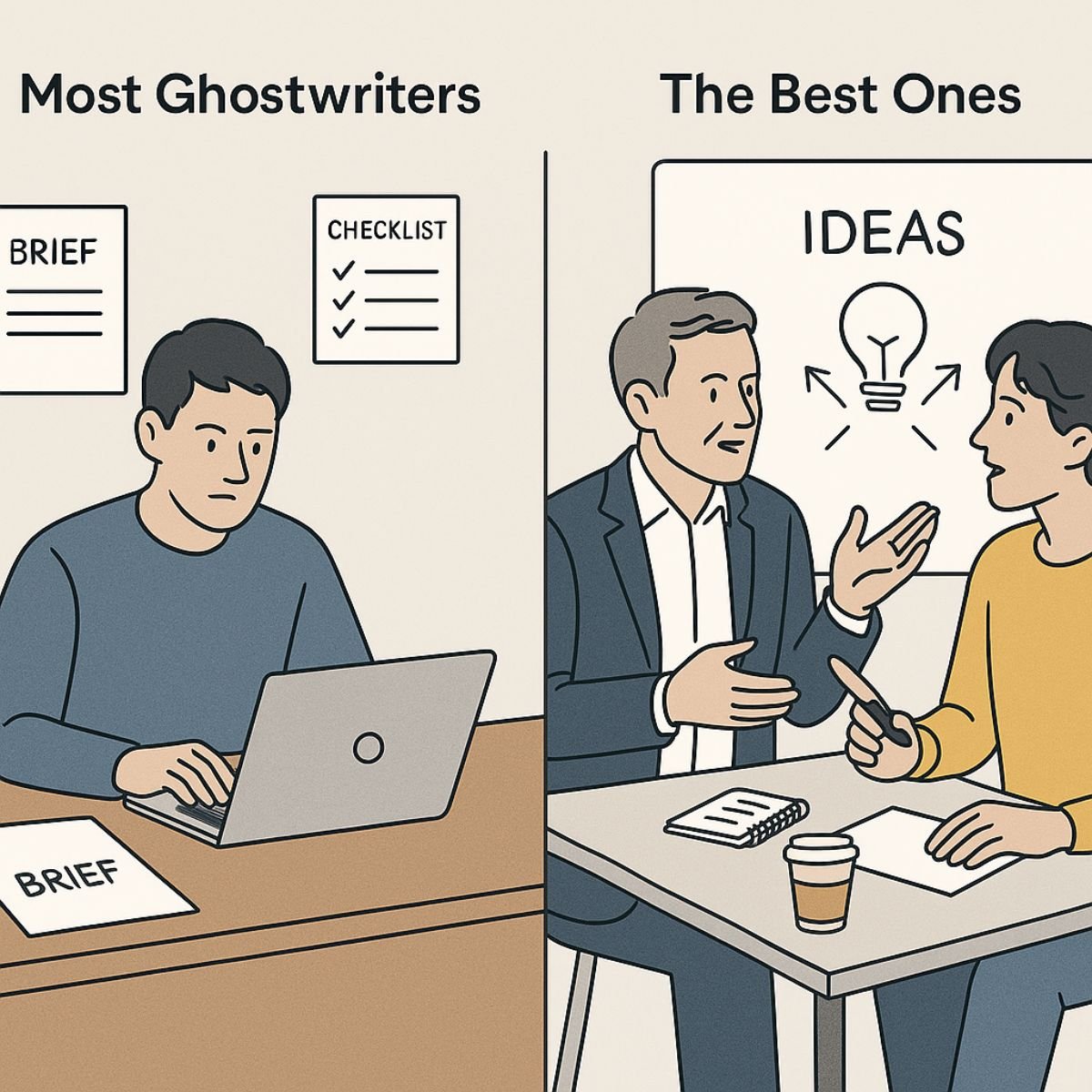
Most founders who struggle with content assume they just need a “better writer.” Someone to take their ideas, polish them up, and turn them into readable posts or articles.
So they hire a freelancer. Or a marketing agency. Or sometimes even a full-time content hire.
And what they usually get back is… technically fine. It’s grammatically correct. It hits the word count. It sounds smart. But it feels generic. It lacks edge. It could’ve been written by anyone.
That’s not a writing problem. That’s a message extraction problem.
Great ghostwriting doesn’t start with writing. It starts with listening. It starts with a challenge. It starts with a deep understanding of how founders think—and what keeps their thinking from becoming a narrative.
Most writers work from briefs. Real ghostwriters create the brief with you.
They don’t just ask, “What do you want to say?” They ask, “What do you believe that most people don’t?”
They hear the insight inside a throwaway line.
They know when to push back—and when to dig deeper.
This is why many founders say, “It just doesn’t sound like me.” Because the writing was built from secondhand assumptions, not primary source material. It was surface-level language applied to an unspoken strategy.
But your message isn’t surface-level. Your story, your worldview, your edge—it lives underneath what you say in meetings. It comes out in fragments, offhand comments, and deeper reflections.
And unless your writer knows how to mine for it, you’ll keep getting content that represents you—but never reflects you.
A real ghostwriter works like a strategist.
They spot your frameworks before you name them.
They organize your raw thinking into positioning you can repeat.
They help you clarify not just what to say, but why you’re saying it in the first place.
This is what most founders are missing—not content support, but intellectual partnership. Not more words, but better architecture. Not fluff that fills a blog, but sharp thinking that shapes perception.
Because if the content doesn’t move you as the founder, it won’t move anyone else either.
So before you hire another “content writer,” ask yourself:
Am I looking for words—or for someone who can help me lead with them?
Section 8: What the Top 1% Do Differently — How Smart Founders Build Authority Through Message, Not Just Media
By now, it’s clear that most founders aren’t failing at content because they lack skill or ambition. They’re failing because they misunderstand what content is really meant to do—and how to lead it.
But there’s another category of founder entirely. A small percentage—the top 1%—who approach content with a different mindset.
They don’t chase hacks. They don’t panic-post on LinkedIn. They don’t spread themselves thin across platforms just to “stay visible.”
Instead, they do something quietly radical:
They treat content as a business asset—not a marketing task.
These founders understand that content isn’t just about reach. It’s about reputation. It’s not just about growth—it’s about gravity. Their content doesn’t chase clients.
It attracts the right ones by standing firm in what they believe and repeating it consistently.
So what exactly do they do differently?
First, they own a core message.
They know what they want to be known for. They aren’t trying to be everything to everyone. They’ve chosen a strategic idea—often rooted in a market tension or unpopular belief—and made it central to how they show up.
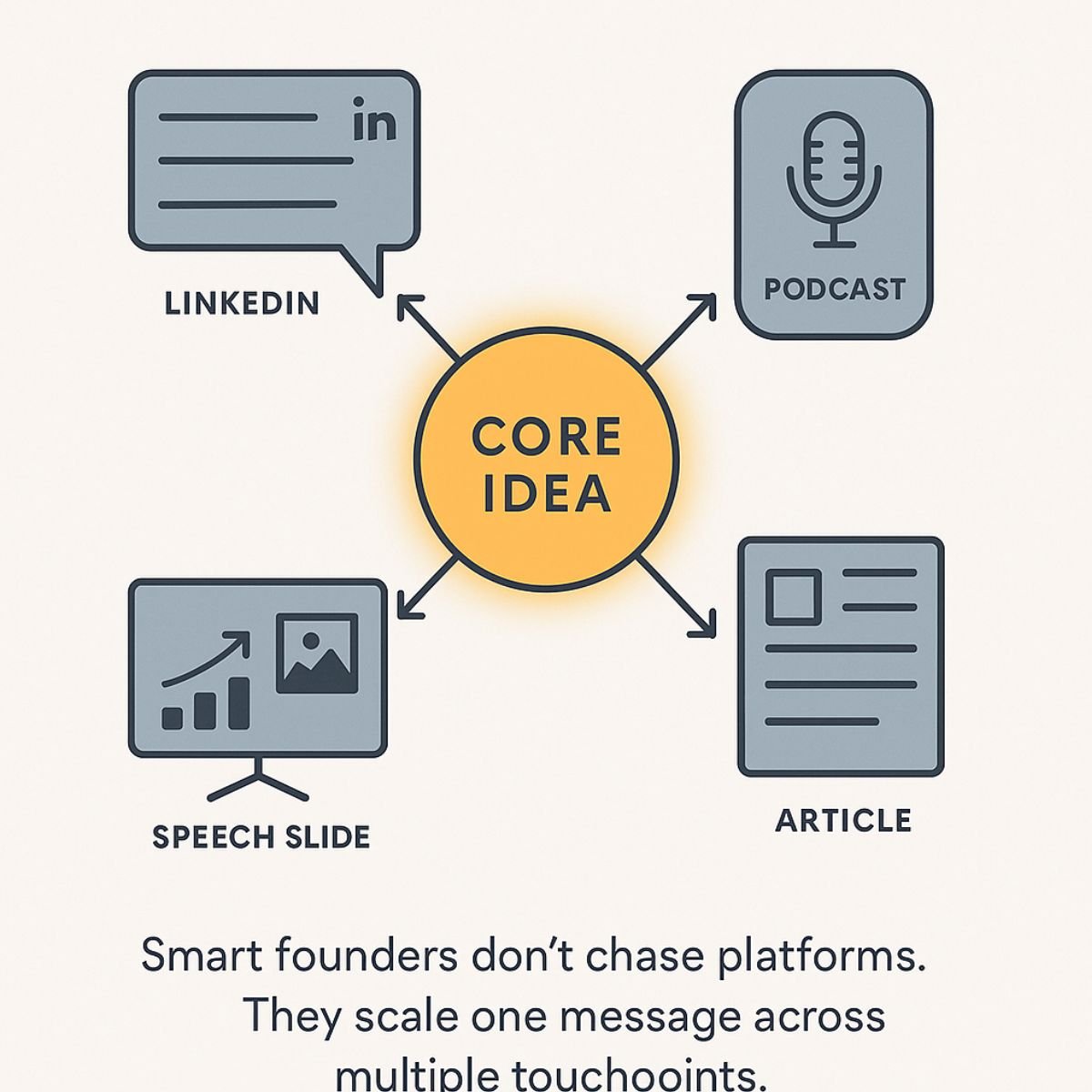
Second, they repeat that message across formats, not platforms.
They may publish on LinkedIn, in podcasts, or newsletters—but it’s not scattered. It’s one cohesive narrative, expressed in multiple ways.
One idea, many doors. That’s how they scale insight without losing voice.
Third, they collaborate with strategic partners who help them stay sharp.
They don’t just hire ghostwriters to write “content.” They work with thinkers who challenge them, who spot patterns in their frameworks, who help them say the same thing ten different ways without diluting the message.
And finally, they lead with clarity, not volume.
They’re not shouting. They’re not publishing daily just to hit a quota. They publish when they have something to say—and because it’s rooted in insight, their audience listens.
Not out of obligation, but because the content reflects a level of thinking that’s hard to find elsewhere.
This is the difference between looking busy and building authority.
The top 1% use content as leverage.
They don’t just participate in the conversation—they shape it.
And they don’t do it alone. Behind most of these founders is someone—often invisible—who’s helping them turn scattered thinking into sharp strategy. Someone who listens deeply, distills clearly, and writes in a way that feels unmistakably them.
That’s not content creation. That’s brand leadership.
Section 9: Mini Case Studies — Real Examples of Founder Messaging Before & After
It’s easy to talk about content strategy in theory. But what does it actually look like when a founder clarifies their message, partners with the right ghostwriter, and shifts from noise to narrative?
Below are three short, anonymized examples based on real client transformations. Each one highlights what changed—not just in content, but in perception, authority, and inbound traction.
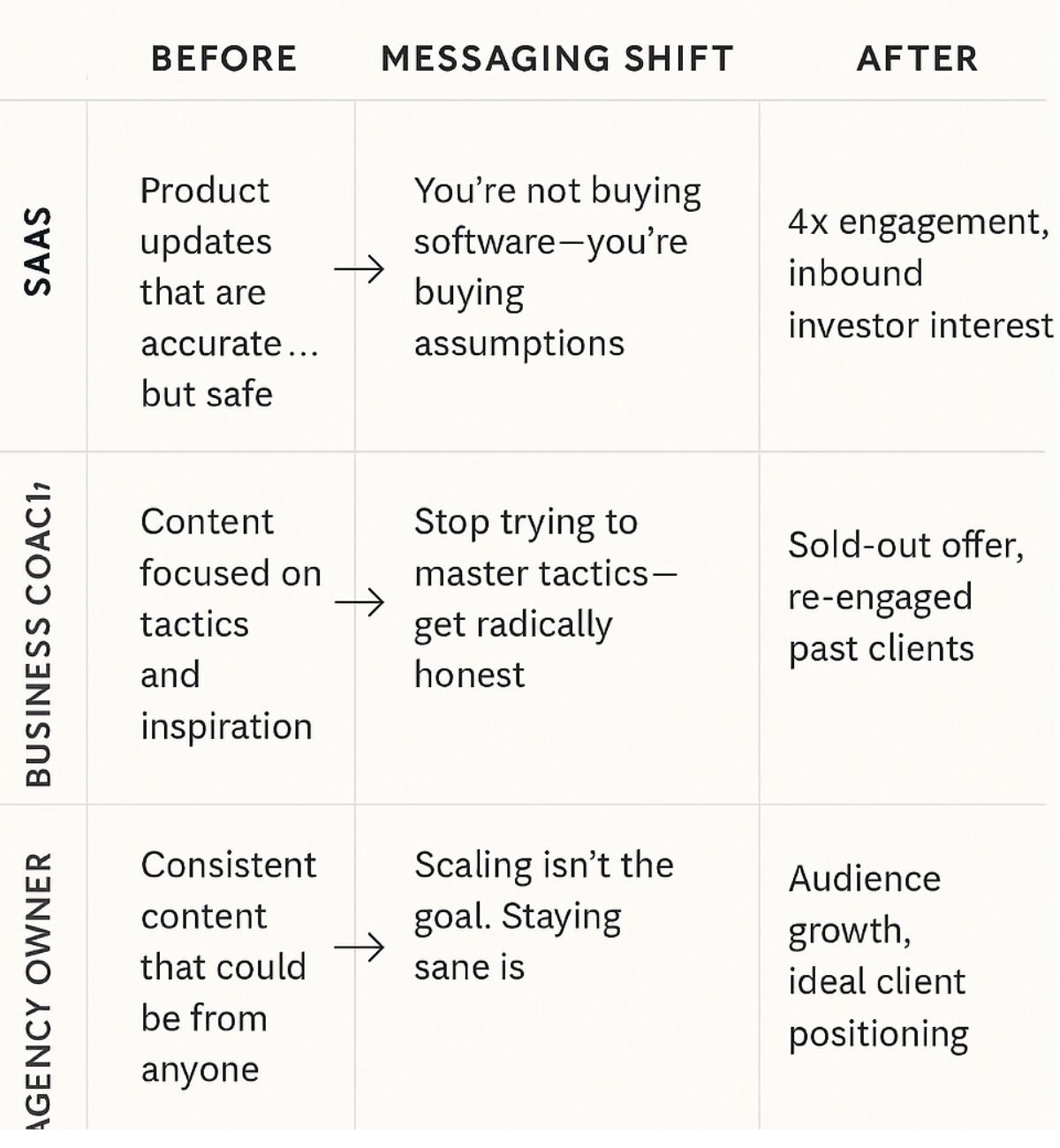
Case Study 1: The SaaS Founder Who Went From Product Updates to Industry Provocation
Before:
Weekly posts on new feature releases, integrations, and company milestones. Technically accurate—but bland. Low engagement. No strong founder presence. The brand was respected, but not remembered.
After:
We extracted the founder’s frustration with how enterprise buyers misunderstand the software category. That became the anchor idea: “You’re not buying software—you’re buying assumptions.” This led to a series of sharp, founder-led posts reframing industry norms.
Results:
- 4x engagement on LinkedIn within six weeks
- Two inbound podcast invitations
- A direct investor conversation initiated via DM saying, “This is finally something different.”
Case Study 2: The Business Coach Who Sounded Like Every Other Coach
Before:
A mix of how-to content, motivational quotes, and reposted client wins. It looked professional—but lacked edge. Nothing about her content revealed how she thought or what she truly believed.
After:
We narrowed in on her actual belief: “Most entrepreneurs don’t need more tactics. They need to stop lying to themselves.” It became the backbone of a tough-love, clarity-first messaging strategy.
Results:
- New consulting offer sold out with no ad spend
- Former clients re-engaged saying, “This finally feels like you again.”
- Content saves her time in sales calls—it now filters ideal clients upfront
Case Study 3: The Agency Owner Who Was Posting Consistently (and Getting Ignored)
Before:
She followed every growth playbook. Hooked headlines. Weekly carousels. Podcast appearances. But still—low traction. Why? Because everything sounded like a remix of other creators. No original lens.
After:
We unearthed her core belief: “Scaling is not the goal. Staying sane is.” It became her through-line. Every piece of content—long or short—connected back to that point of view.
Results:
- Audience doubled in 90 days
- Became a go-to voice for “sustainable scale” conversations
- Clients now come in saying, “I’ve been bingeing your stuff for weeks”
These shifts didn’t happen because the writing got better.
They happened because the thinking got sharper—and the message got repeated.
That’s the real power of founder-led content: not just creating, but owning a space in your audience’s mind.
And that only happens when you build from clarity, not content trends.
Section 10: Conclusion — You’re the Founder. You’re the Flag.

Content marketing is not a side task. It’s not something to delegate and forget. And it’s certainly not about chasing algorithms or repurposing trends just to “stay visible.”
For founders, content is how you lead when you’re not in the room.
It’s how you shape perception at scale.
It’s how you build trust long before the sales call ever happens.
But that only works when your content is anchored in clarity—when it comes from a message you own, a belief you’re willing to repeat, and a worldview you’re ready to lead with.
The mistake most founders make isn’t underinvesting in content.
It’s a misunderstanding of what content is for.
It’s not about more words. It’s about sharper thinking.
It’s not about showing up everywhere. It’s about saying one thing well, over time, in multiple ways.
That’s the difference between content that performs—and content that positions.
Between being part of the noise—and becoming a voice that people follow.
If you’re the founder, you’re the flag. Your ideas are the signal your audience is looking for. But only if they’re visible. Only if they’re consistent. Only if they’re shaped into a message that actually moves people.
And that’s where strategic ghostwriting comes in.
Not as a service to “take content off your plate.”
But as a thinking partner.
As a translator of your insight.
As someone who helps you lead, not just publish.
You don’t need to write more. You need to lead more clearly—with words that feel like yours, and a message that leaves a mark.
And when you’re ready to build that kind of clarity?
I help founders do exactly that.